
ALMA 2026
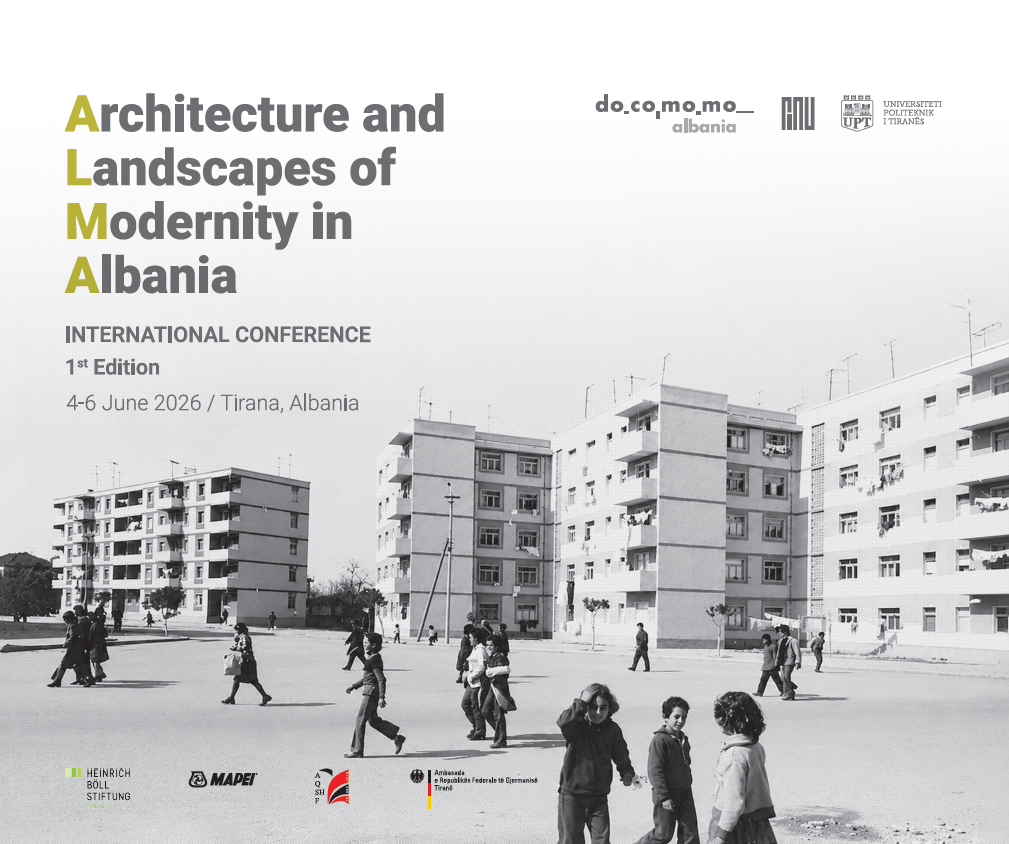
Architecture and Landscapes of Modernity in Albania
ALMA 2026 is the first edition of the international conference Architecture and Landscapes of Modernity in Albania, organized by DoCoMoMo Albania in partnership with the Faculty of Architecture and Urbanism, Polytechnic University of Tirana. ALMA 2026 is the inaugural event of the ALMA conference series.
The conference explores how processes of modernity – political, social, technological, and economic – have shaped Albania’s architectural, urban, and territorial landscapes from the early twentieth century to the present. It promotes an integrated understanding of modernization across architecture, planning, industry, infrastructure, and the built environment.
ALMA welcomes contributions on all scales of modernity: from product design and interiors, to buildings, public spaces, urban environments, and infrastructures. It encourages research addressing ideology, propaganda, civic symbolism, material culture, and everyday life, and strongly supports the recognition, documentation, conservation, and valorization of the material legacies of Albanian modernity.
Participants include scholars, architects, planners, engineers, historians, conservators, anthropologists, and representatives of cultural and heritage institutions. The event aims to promote interdisciplinary dialogue, expand public awareness, and advance the study and preservation of architecture shaped by Albanian modernity.
Conference Themes
1. Modernity, Ideology, and Socio-Political Contexts
- Interwar modernization, state formation, and institutional reforms
- Socialist period modernization, ideological programs, propaganda, and civic symbolism
- Everyday life and social uses of buildings and spaces (housing, education, work, culture)
- Cultural infrastructures, exhibitions, interior environments, and visual communication
- Public art, monuments, and artistic practices as expression of modernity and collective memory
- Interpretation of socio-political values in heritage recognition and assessment
2. Urbanization, Planning, and Infrastructure
- Urban growth, regional planning, and territorial policies throughout the twentieth century
- Transport systems, industrial zones, utilities, and infrastructural landscapes
- Planning principles, experimental projects, and restructuring processes
- Recognition and conservation of urban and infrastructural heritage shaped by modernity
3. Building Typologies and Heritage
- Residential, industrial, commercial, administrative, educational, and cultural buildings
- Typological studies of interwar buildings, socialist-period public works, and transitional-era projects
- Documentation, conservation, restoration, and adaptive reuse
- Public engagement, awareness strategies, and heritage valorization
4. Technologies, Materials, and Design Practices
- Construction techniques and material innovations associated with modernization
- Industrialized methods, prefabrication, and structural experimentation
- Interiors, furniture, product design, everyday objects, and functional design
- Technical knowledge and material performance in understanding modernity-driven heritage
5. Documentation, Representation, and Digital Methods
- Archival sources: maps, photographs, drawings, publications, and visual culture
- Digital surveying, photogrammetry, 3D modelling, VR/AR, and GIS applications
- Historical and analytical methods for documenting modernity in architecture and landscapes
- Digital tools for communicating and promoting Albania’s modern heritage
6. Comparative and Interdisciplinary Approaches
- Comparative studies of modernization in the Balkans, Mediterranean, Europe, and beyond
- Interdisciplinary research across architecture, planning, engineering, history, anthropology, geography, and design
- Innovative frameworks for interpreting sociocultural and environmental impacts of modernization
- Cross-national exchanges, influences, and collaborations